Kenyon Ndezi
  • Home
  • Discover
  • Finance
    • Business
    • Banking
    • Invest
  • Lifestyle
    • Travel
    • Food
  • Blogging
    • SEO
    • Troubleshoot
    • Themes
    • Plugins
    • WordPress Tips
featured
  • Wealthsimple Trade: The Robinhood Of Canada.
    • June 30, 2021
  • Wealthsimple invest
    Wealthsimple Invest Review: Anyone Can Invest In Autopilot!
    • June 30, 2021
  • Be Forward Buyers Guide: How To Buy and Import a Car to Tanzania, Africa
    • March 10, 2023
  • Walmart Rewards Mastercard – A Shopper’s Dream
    • July 25, 2023
  • How To Migrate A WordPress Site From Shared Hosting To A VPS Server Using Only Plugins.
    • September 5, 2021
Kenyon Ndezi
  • Home
  • Discover
  • Finance
    • Business
    • Banking
    • Invest
  • Lifestyle
    • Travel
    • Food
  • Blogging
    • SEO
    • Troubleshoot
    • Themes
    • Plugins
    • WordPress Tips
Home Posts How To Hide Widgets On Specific Posts And Pages In A WordPress Site.
  • Plugins

How To Hide Widgets On Specific Posts And Pages In A WordPress Site.

  • August 24, 2021
  • Kenyon Ndezi
Total
2
Shares
0
0
2

Widgets are blocks of content that you add to your site in various locations, such as the footer, sidebar, top, below, or anywhere in your site. Different widgets provide various functions that enhance the user experience, showcase information, or add additional functionality. Occasionally, you might want a widget to only show on a specific page as opposed to the entire site. This will be helpful for widgets found on footers and sidebars that appear on every page.

Download the “Widget Context” Plugin.
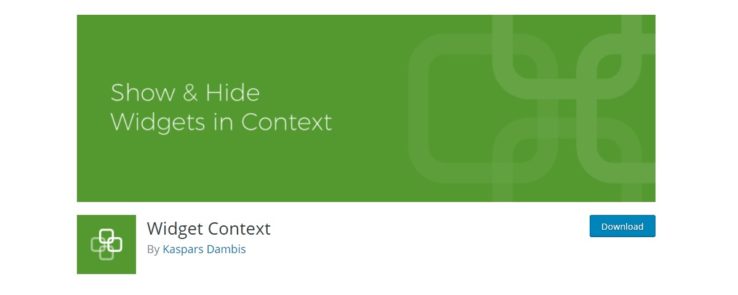
Nothing is annoying as having a pesky widget that seems to appear on every single page or post. Widget Context plugin allows you to show or hide widgets on any section of the site.

  • To download Widget Context, head over to Plugins on your WordPress admin panel and select “Add New.”
  • On the search bar, type in the word “Widget Context.”
  • Click “install” when the plugin shows up.
  • Activate the plugin after installation.

How to use the “Widget Context” plugin.
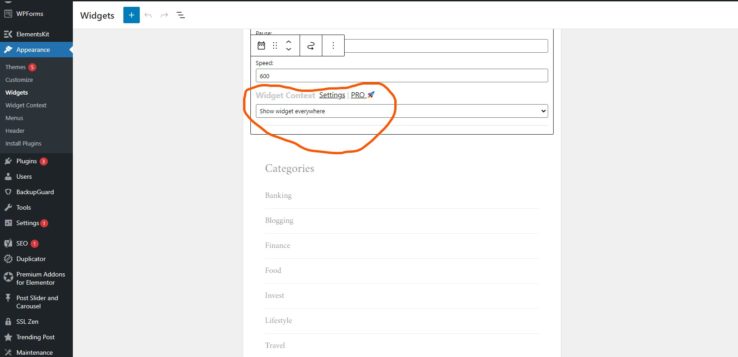
Head over to Appearance>Widgets and select the widget of choice. In the Widget settings, you’ll see the “Widget Context settings” that will allow you to display or hide widgets on different sections of your site. These settings can also be accessed on the front end of the website by clicking Cutomize>Widgets on the setting of your site. 

There are many settings to select from such as:

  • Show widget on selected (This allows you to select specific pages and posts that will show the widget)
  • Hide widget on selected
  • Show widget everywhere
  • Hide widget everywhere. 

Why would you want to hide or display widgets on your site?

  • Some themes will display the same widget on every single page of a site. This might be intrusive, especially on pages that don’t need it. An example would be a widget that showcases “trending posts” on the footer of your site, however, you might not want that information on your “About Us” page. Using “Widget Context”, you’ll be able to decide where the widget will appear.
  • The plugin also allows you to showcase widgets on all pages of your site. You might have a Newsletter sign-up widget that you want to display throughout the site to collect emails.

Get your blog up and running

Blogging is a highly lucrative venture for anyone who wishes to make passive income. To get started with blogging, read this article to get you started.

Total
2
Shares
Share 0
Tweet 0
Pin it 2
Kenyon Ndezi

Kenyon Ndezi is a recent graduate, writer, creator of vividbay.com, and the owner of Neonbuild.com, which is a company focused on building apps for small businesses and individuals. Follow along and get inspired!

You May Also Like
View Post
  • Plugins

Solving Duplicate Content Issues: Use the Bulk Move Plugin to Manage posts in Multiple Categories

  • Kenyon Ndezi
  • September 12, 2023
View Post
  • Plugins

10 Essential WordPress Plugins for Your Blog

  • Kenyon Ndezi
  • April 16, 2023
View Post
  • Plugins

How To Migrate A WordPress Site From Shared Hosting To A VPS Server Using Only Plugins.

  • Kenyon Ndezi
  • September 5, 2021

Leave a Reply Cancel reply

Your email address will not be published. Required fields are marked *

Featured
  • DIY Party Planning: Ideas and Inspiration for Every Celebration
    • April 17, 2023
  • CIBC US Smart Account: A Travel Companion
    • November 5, 2021
  • How to Create a Budget and Stick to It
    • April 17, 2023
  • Why I Regret Putting a Bed in My Office
    • January 29, 2026
  • Solving Duplicate Content Issues: Use the Bulk Move Plugin to Manage posts in Multiple Categories
    • September 12, 2023
Latest
  • Why I Regret Putting a Bed in My Office
    • January 29, 2026
  • Conquer That Interview: Your Guide to Ace Your Next Opportunity
    • February 2, 2024
  • Why I usually finish my Google searches with Reddit
    • February 1, 2024
  • Why is There no Uber in St. John’s Newfoundland?
    • January 31, 2024
  • A Practical Guide to Canadian Immigration: How to Write Explanation Letters Without Over-Reliance on ChatGPT
    • November 9, 2023
Categories
Banking
11 Posts
View Posts
Blogging
5 Posts
View Posts
Business
10 Posts
View Posts
Finance
15 Posts
View Posts
Food
3 Posts
View Posts
Invest
14 Posts
View Posts
Lifestyle
9 Posts
View Posts
Travel
15 Posts
View Posts
Wordpress Tips
5 Posts
View Posts
You Might Like
  • 1
    101 Things To Do in Toronto
    • June 17, 2022
  • chair in the desert, with a cloud looming on top. 2
    This is how I ranked on the 1st page of Google without researching keywords/SEO on my tech blog
    • November 3, 2022
  • 3
    Should You Use Google Adsense Auto Ads?
    • January 18, 2022
  • 4
    Affordable DIY Home Decor Ideas: Simple and Stylish
    • April 17, 2023
  • 5
    How To Be More Productive.
    • January 28, 2021
SUBSCRIBE TO OUR NEWSLETTER
Kenyon Ndezi
  • Contact
  • About
  • Privacy Policy
Business & Lifestyle

Input your search keywords and press Enter.